Saturday, May 9, 2009

Arch Stanton? Are you sure?

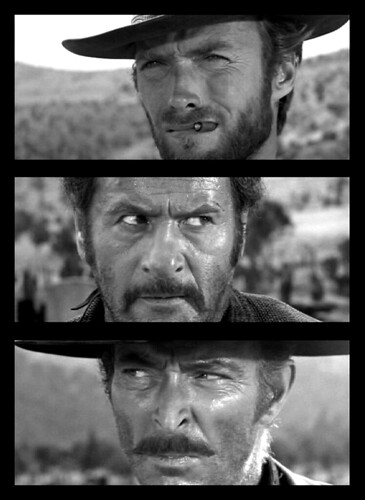
The good, The Bad and The Ugly(1966)

Directed by: Sergio Leone
Produced by:Alberto Grimaldi
Starring:
Clint Eastwood
Eli Wallach
LeeVan Cleef
Music by: Ennio Morricone
Cinematography:
Tonino Delli Colli


The 50's and the 60's saw the Western genre reach its peak of popularity. Leading men like the legendary John Wayne and Gary Cooper had captured the imaginations of an entire generation.In the middle of it all, in a genre dominated by American directors and actors, an Italian production company hired an Italian director to shoot a western in Italian, with a pre-dominantly Italian crew. Funny how history is made in the most unlikely of ways.There was no righteous Sheriff, or the hero who was justice personified. This is a story of what men really are, and a story of the reality of those times, not the romanticized view of the Duke riding into the sunset with his lady-love.There was grit, greed, violence , treachery and deceit. Just makes you wonder , why didn't they think of this before???

This is the story of 3 men,living on their own terms, in a time when only the strong, the rich and the quick could afford to do so. Blondie( Eastwood) is a mysterious lone gunman, who makes a living out of collecting bounties on Tuco (Wallach), a criminal with a list of crimes to his name which is almost as long as his name itself, and subsequently helping him escape during his executions. We soon realise its a partnership born purely out of convenience,and they have a great deal of mutual resentment towards each other.And then there's Angel-eyes ( Van Cleef), the ruthless man-hunter, hot in pursuit of a missing gold cache belonging to the military.The entire movie revolves around the aforementioned demi-treasure. The path of these three men cross constantly during the mad dash for the loot, and uneasy alliances are made, and broken just as easily. They come face to face with the realities of their times, the horrors of a war where brother fought against brother. But above everything else, its an adventure of epic proportions, executed with utter perfection by these "outsiders" of the genre.

The Good... has , over two generations, become synonynous with the Western genre, and why shouldn't it? The casting coup that was getting the young American actor ,Clint Eastwood(fresh out of the sets of the moderately successful show Rawhide) to play the silent Blondie, the brilliant Eli Wallach as the
mad-as-a-rattlesnake's-armpit bandit Tuco, and Van Cleef as the ruthless, cold-blooded killer known as Angel Eyes. But for me, the major triumph in this movie is the background score provided by the legendary composer Ennio Morricone. Every score is inch perfect in going along with the movie's mood, with a special mention of the background score during the climax, and Oh! What a climax it is.The story-telling is near flawless, the action, though in spurts, is extremely intense .The acting , especially by Wallach, is top notch and the camera work is precise and full of flair.The only slight flaw i could think of is the pacing which is a bit off in the build up to the climax(if you have seen it, you know which part i'm talking about).

All in all, this movie is a masterpiece, a true classic. Westerns have had better stories, better acting, better direction (The Unforgiven), but thay have never been as entertaining,enticing as this one. Ill Buono, Ill Bruto, Ill Cattivo rightfully takes its place alongside other landmarks of the visual medium, as movies we look back at and say" they don't make 'em like those anymore" .

Friday, May 8, 2009

A Spectacle Like No Other


Hum Aapke Hain Koun...! (1994)
Directed by : Sooraj R. Barjatiya
Produced by : Rajshri Productions
Starring:
Salman Khan
Madhuri Dixit
Anupam Kher
Alok Nath
Renuka Shahane
Laxmikant Berde
Music by: Raamlaxman

Made as a modern day remake of "Nadiya Ke Paar",another Rajshri Productions classic, this movie turned out to be a financial juggernaut, the likes of which Indian cinema had never seen before. Families flocked to the theatres(including yours truly's) to experience this phenomenon. A sudden pressure was felt by every groom-to-be's younger brothers to be funny and flamboyant at weddings, or in other words , " to pull off a Prem".
This is Indian cinema at it's most unrealistic(though its about everyday life), most unapologetic," finger to the critics cuz this is what the people want". This is HAHK....!

The film follows the lives of an extremely rich family. The patriarch, played by Alok Nath , is the ultimate father figure, and his 2 nephews, Rajesh ( Mohnish Bhel) and Prem( Salman Khan) , love him like they must have loved their late father.Now on the outside, it looks like they arent lacking for anything, but the uncle and Prem both agree that the family lacks a woman's motherly presence. This leads to some " photo dikhai" which leads to the uncle remembering that his college friend, now a professor(Anupam Kher), has a daughter of the appropriate age(how convenient is that?). So after a brief period of getting to know each other, and courting which firmly belongs in the early nineteenth century, Rajesh and Pooja (Shahane) get engaged and eventually married, and there is song and dance and a whole lotta in-your-face merry making.
But therein lies the problem. The entire spectacle makes you sort of realize that you're never gonna be as happy in real life as those people are on the screen. These people are constantly acting as if they are overdosed on Prozac, and would not notice if someone walked up to them and shot them in the foot. It really makes you wanna go on and punch them just to make sure they are aware of the concepts of pain.
And as if on cue, the two most attractive members of the cast develop some feelings towards each other, and these feelings are based on nothing more than having sung a few duets and danced around a little, but still, love moves in mysterious ways. So Prem and Nisha, who are almost unabashedly at the focus of everything in the film, begin their courting, which is youthful enough to belong in the 1950s, and this develops into the love story it was always meant to be. Special mention to be made of Satish shah as the hammy "shaayar" doctor uncle,Laxmikant Berde as the comic relief/"apne ladke ke jaisa" servant, and Tuffy, the super deus-ex-machina dog.

Now technically, this movie is first class by Indian stndards. The music is melodious and extremely catchy, as we can glean from its tremendous popularity. The camera work has no evident flaws, the film is paced decently(yes, inspite of the gazillion songs). the problem starts with the fact that Sooraj Barjatiya comes across as someone who has lived his life inside a "Barbie's skirt" coloured pink bubble with fluffy,furry inside walls. He seems to lack any understanding regrding how a human being reacts to a situation. It might be intentional, which would make him a genius, but his later offerings suggest otherwise. I think the main reason for this movie's phenomenal succes can be the fact that its about regualr people, but it's not. It's a tease, it's a " get an eyeful cause you're never gonna have a life like this for real". A big negative that comes to mind for this movie is that the shit-loads of money that Rajshri made with this was used to finance " Main Prem Ki Diwani Hoon". Well , love it or hate it( i'm still undecided on that one myself) , you just can't ignore it. I mean, admit it, you've probably seen this at least half a dozen times.
This movie has a very unique position in the history of Indian cinema, as a financial messiah and a creative plague for the industry. It means different things to different people, but it is , and always will be a spectacle like no other(yay!incorporated the thread title!)

A Beginning of Numerous Journeys....


Pather Panchali(1955)

Directed by : Satyajit Ray
Produced by: The Government of West Bengal
Starring:
Kanu Banerjee
Karuna Banerjee
Chunibala Devi

Uma Dasgupta
Subir Banerjee
Music by : Ravi Shankar
Cinematography: Subrata Mitra
Based on the Novel " Pather Panchali" by Bibhutibhushan Bandopadhyay


Fresh from having assisted Jean Renoir in the filming of "The River", and deeply moved by De Sica's "The Bicycle Thief", a young Satyajit Ray was convinced that movie-making was his truest calling. Thus he went on , through various budgeting disasters,and working with an almost entirely inexperienced crew, to craft what many people,critics or not, consider to be the greatest Indian movie ever made.

The backdrop for this rural Indian saga is ,you guessed it, a pre- independence village in Bengal, where we follow the everyday lives of the priest, Harihar, and his family. Family is his wife Sharbojaya, two children,daughter Durga and son Apu(the protagonist of the trilogy), and Harihar's widowed aunt, Indir Thakrun, whose stay with them is more or less an act of charity on the part of Sharbojaya.We witness how Durga has something of a tomboyish streak, and how the neighbors misinterpret her stealing fruits from trees to be something done out of need rather than childishness. We see how Harihar struggles to find work in a profession which faced something of a saturation back then.We see how Sharbojaya is gardually getting frustrated with her domestic life, and how she vents that frustration on Durga ,and Indir Thakrun at various points of time.
We see a little girl and her even littler brother following the "mishti waala" with nothing but optimism on them, maybe thinking "what if he gives us some out of sheer generosity?" We see a man, well aware of the fact that he's not able to fulfill his duties towards his family, masking his disappointment with false hopes, which , at some point of time, he himself begins to believe in.We see the old widow, unwanted, unappreciated, the world treating her with indifference to the extent that death seems like a welcome release for her. We see tragedy strike people whose very existence is burden enough for them. But at the end of it all, we se the human spirit and it's uncanny nature to emerge stronger out of despair and shit-storms.

Now on to the technical aspects of this masterpiece. I'll be bold enough to claim that this movie bests almost anything America or Europe had to offer on that front.The camera work by Subrata Mitra( a frequent collaborator with Ray after this) is nothing short of masterful. The image of the children walking along the river bank, and their reflections in the clear water, is something that has stayed with me. The score for the movie was provided by the then relatively unknown Pt Ravi Shankar,and you know what? That guy has some serious talent!! The actors , especially the child artists, pull off their parts with tremendous professionalism. Special mention has to be made of Chunibala Devi's portrayal of Indir Thakrun, and how precisely she emotes and reacts as someone in that situation would. In fact, it is one of Ray's forte, to clearly understand how a human being would react in a particular situation. It sounds simple enough, but only the greatest of Auteurs possess this understanding. Considering this movie was made on a budget of Rs 1.5 Lakhs, the fact that it is called a techinacal mastrpiece is a tribute to Ray's efficiency as a film-maker.

Now i have absolutely no negative points for this movie. I know it sounds like something of a cop-out, but it's true. This is a perfect movie, and i m yet to see anything, from any country, which bests this champion of Indian neorealism cinema. With this movie, began the journey of a Director who went on to achieve greatness of the sort few else can lay claim to, but im sure even Ray must have looked back at this and patted himself on the back a little,from time to time.